
I would love to weave a quaint little tale about how I first discovered Tove Jansson’s work in a charming independent bookstore, but that isn’t how the story goes.

I did, though, take photos for this post at Toronto’s Oakwood Espresso, a charming independent coffee shop. So I’ll start with a picture of this beloved local meeting place to shore us up for a dive into the world of big-box chain bookstores.
I was living in Oxford, England, and working at Oxford University Press, when I encountered Tove Jansson’s work for the first time.
Although I’ve been a keen reader since childhood, I had never heard of her — I wasn’t even acquainted with the internationally renowned Moomin series of children’s books for which she is best known.
Toward the end of one of my Saturday meanderings through Oxford — a city with no shortage of beautiful bookstores — I found myself, for reasons I can’t explain, wandering into the nondescript big-box Borders Books.
A masterpiece of microcosm, a perfection of the small, quiet read.
From Ali Smith’s Guardian review of The Summer Book

I had just passed the line of impatient customers waiting at the checkout when I spotted, dotting the end of a heavy, industrial-sized bookcase, what looked like a series of bright blue jewels. I was drawn to them like a magnet.
The jewels turned out to be copies of the 2003 reissue of The Summer Book, published by Sort of Books two years after Jansson’s death (she died in 2001 at the age of 86).
As Sort of Books so aptly describes, The Summer Book book is the story of “An elderly artist and her six-year-old grand-daughter [as they] while away a summer together on a tiny island in the Gulf of Finland. As the two learn to adjust to each other’s fears, whims and yearnings, a fierce yet understated love emerges – one that encompasses not only the summer inhabitants but the very island itself.”
In her Guardian review of this glittering edition, Ali Smith touches on the incongruity of seeing a gem like The Summer Book be released into the noisy culture of what she called these chainstore times:
“What a strange media heist it all is. What a huge noise it makes. It makes a reissue of Tove Jansson’s 1972 novel The Summer Book seem like a butterfly released into a room full of elephants; it makes such a reissue – a masterpiece of microcosm, a perfection of the small, quiet read – even more of a relief.”
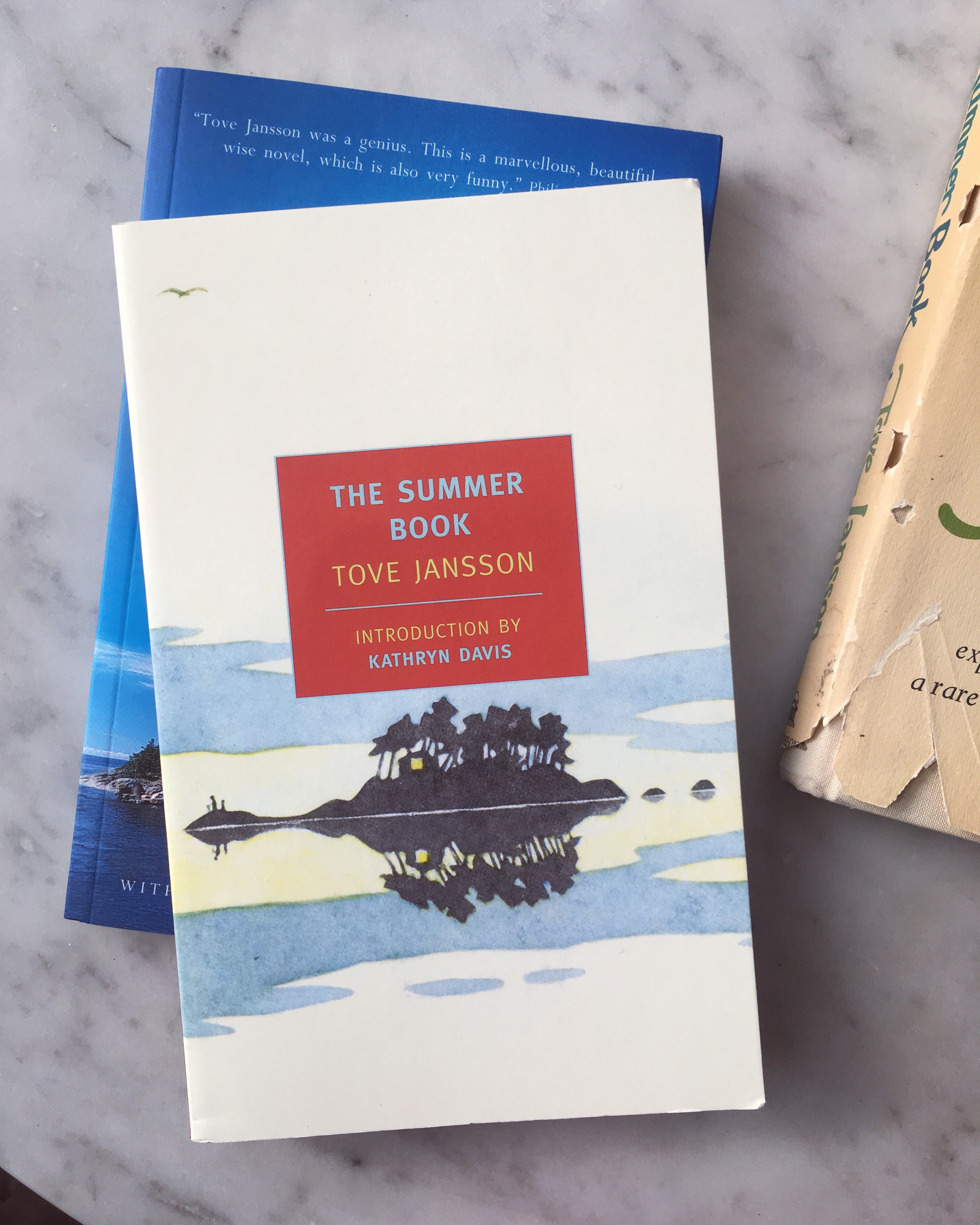
I now have three editions of The Summer Book on my shelf:
- The 2003 Sort of Books edition
- A delightful paperback published by New York Review Books in 2008
- A much-loved second-hand hardcover edition published by Pantheon Books in 1974

While the three publishers take a different approach to their cover design, I think the “butterfly” nature of each edition is obvious.
There are no elephants here.
Tove Jansson writes with a special toughness and lack of sentiment, and with a quiet, almost drastic sense of humour about life perceived through these two people at its extremes; one just beginning, the other about to end.
Quote from Anne Morrow Lindbergh, from the front flap of the 1974 edition of The Summer Book published by Pantheon Books.
______________
 Catalogue